
Holyrood Round Table Rural Communities Speak Out
Garve and District Community Council
Added at 14:22 on 14 March 2026
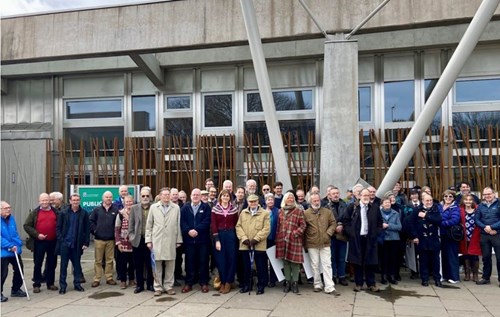
Community Councils from across Scotland gathered in Holyrood, on 24th February 2026, for a landmark round table discussion on the rapid expansion of major energy infrastructure in rural areas. The event brought together representatives from the Highlands, the South of Scotland, the North East and island communities to share their experiences directly with ministers, organisations and fellow community representatives. Those unable to attend in person attended online via Zoom.
This meeting of the coalition of Community Councils including ours, marked the first time that such a wide group of elected community representatives had come together at the heart of Scottish democracy to discuss the cumulative impact of renewable energy development on rural Scotland.
The gathering was organised under the banner of the Rural Scotland Convention on Major Energy Infrastructure, a forum established by community councillors seeking to ensure that the voices of rural communities are heard as Scotland continues its transition to a low-carbon energy system.
A central theme of the discussion was the pace and scale of development being proposed across many rural areas. Community Councillors described how their local planning systems are currently facing an unprecedented number of applications for wind farms, substations, battery storage sites, grid infrastructure and associated works.
While many participants acknowledged the importance of addressing climate change and supporting renewable energy, speakers repeatedly raised concerns about the lack of a coherent national plan guiding where and how this infrastructure should be developed.
A unified statement from the Convention called for three key measures: a temporary pause on major energy infrastructure applications, the development of a clear national energy policy, and the establishment of a Scotland-wide Planning Inquiry Commission to assess cumulative impacts.
Participants argued that the current system often considers individual developments in isolation, leaving communities to deal with the combined effects of multiple large-scale projects without any overall assessment of how they interact.
Throughout the round table, community councillors highlighted the growing pressure on local volunteers tasked with responding to highly technical planning applications, often running to thousands of pages of documentation.
Speakers also raised concerns about the potential effects on landscapes, tourism economies, transport infrastructure and fragile rural environments. Many stressed that rural communities are not opposed to renewable energy, but want a transition that is properly planned and developed in partnership with those most directly affected.
The meeting also heard statements from environmental organisations and planning experts, alongside contributions from community representatives from across Scotland.
The round table concluded with calls for a more strategic and collaborative approach to energy planning, one that balances climate ambitions with landscape protection, economic resilience and meaningful local involvement.
The 2 hour round table meeting had been scheduled weeks in advance;- unfortunately Gillian Martin only gave 29 minutes of her time, which was disappointing as may Cllrs had travelled for hours to be there, including Dr. John Heathcote from Contin Community Council. John's insightful contribution, was as with all the others excellent. Unfortuately Ms. Martin had already left by the time John spoke.
The full document from the Holyrood Convention, including the unified statement and detailed contributions from Community Councils across Scotland, is now available to read
here https://bit.ly/RoundTable-Holyrood
It provides a comprehensive record of the discussion and offers an important insight into the perspectives of rural communities at the centre of Scotland’s evolving energy landscape.
To reiterate -
The Convention is not opposing the energy transition. It is proposing practical steps to ensure it is carried out strategically, avoiding a chaotic roll out in the absence of a proper national energy plan.
1. A time-limited pause on major energy infrastructure applications to allow a clear national energy strategy to be put in place.
2. Economic impact assessments to understand effects on rural economies, particularly tourism, agriculture and food security.
3. A Planning Inquiry Commission to examine the national transformation of Scotland’s energy system in a joined-up way and bring an end to the current practice of assessing applications in fragments.
4. A seat at the national table for communities, recognising the Convention as a stakeholder in the upcoming Strategic Spatial Energy Plan.
We are always really keen to hear your thoughts and concerns, you can reach us by email contact@gdcc.scot or phone 01997 414791 leave a message and we will call you back.