
Peatland Restoration – What's Happening on Our Hills?
Garve and District Community Council
Added at 11:11 on 16 July 2026
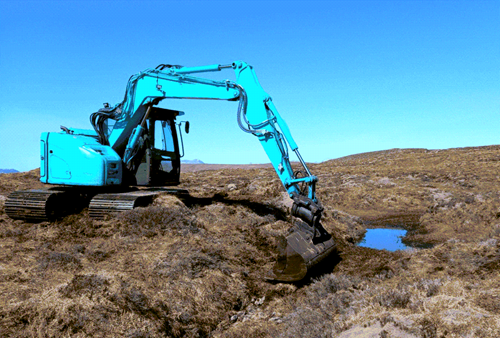
Peatland restoration has become one of those subjects many have heard of, but few people know much about.
It has become a familiar sight across the Highlands, high on the hillside there's an excavator. No new road, no building site, just a digger sitting in the middle of open moorland.
Peatland restoration is happening across Scotland on a scale we've never seen before with government targets to be met, yet most of us only catch glimpses of it through a car window. We see the machinery but rarely hear much about what it's actually doing.
More than just a bog!...
Peatlands cover only around 3% of the Earth's land surface, yet they are estimated to store almost a third of all the carbon held in soils worldwide.
Ask someone to describe peat and they might say it's black, burns well and awkward to walk across!!
Stickly speaking that's accurate, though that's only part of the story.
Peat isn't just soil. It's the remains of plants that have built up over thousands of years because the ground stayed permanently wet. Without much oxygen, the plants never completely decomposed. Year after year, century after century, they slowly accumulated into the peatlands we know today.
That alone makes it rather extraordinary.
Unlike woodland, which can recover within decades, peat takes an incredibly long time to replace. Damage it today and nobody alive now will see it fully recover naturally.
Peat is astonishingly slow to grow. In good conditions it increases in depth by around one millimetre each year. That means it takes about a thousand years to produce just one metre of peat. Stand on a peat bog that's four metres deep and you're standing on around 4,000 years of accumulated plant material. Once it's damaged or lost, it simply can't be replaced within our lifetime, or even within the lifetime of many generations.
That slow build-up also explains why peatlands matter. Every year a tiny amount of carbon is locked away as new peat forms. It takes around fifty years for a square metre of peat to store about two kilograms of carbon, but over a thousand years that can rise to around forty kilograms. Restoring peatlands is therefore about two things: preventing centuries of stored carbon from being lost and giving damaged peatlands the chance to start building again. Along the way come other benefits too, from cleaner water and reduced erosion to healthier habitats for wildlife.
We didn't set out to damage it
It's easy to look at restoration work and assume somebody must have made a terrible mistake.
The truth is rather more complicated.
Much of the drainage that is now being reversed was carried out because, at the time, it was considered good land management. Farmers wanted drier grazing. Foresters needed suitable ground for planting. Estates improved access. Peat was cut for fuel because that was how people heated their homes.
Those decisions reflected the knowledge and priorities of their day.
Only later did it become clear that draining peatland changes far more than the surface.
As the water level drops, the mosses that originally created the peat begin to disappear. The peat itself starts drying out. Cracks appear. Rainwater washes exposed peat into burns and rivers, while wind gradually strips more away.
Some damaged peatlands recover naturally if left alone.
Many don't.
Why are they blocking the drains?
This is probably the question people ask most often.
For decades we dug drains to get rid of water.
Now we're filling them back in.
It sounds back to front until you realise the drains are still doing exactly what they were designed to do, carrying water away from the peat.
Restoration isn't about flooding the landscape.
It's about slowing the escape of water so the peat stays wet enough for the plants that built it in the first place to return.
That may sound like a small change, but water is what determines whether a peatland survives or gradually deteriorates.
Why use excavators?
At first glance, bringing heavy machinery onto fragile ground seems the opposite of conservation.
The reason is simply that some peatlands are now too damaged to repair themselves.
Specialist low ground pressure excavators are used because they spread their weight over a much larger area than conventional machinery. Their job isn't to redesign the landscape but to repair damage that would otherwise continue getting worse.
Old drainage ditches are blocked.
Deep erosion channels are reshaped.
Loose peat is stabilised.
Then the machinery leaves.
After that, nature is expected to take over.
Twenty years on, what have we actually learned?
One thing that often gets overlooked is that peatland restoration isn't new.
Scotland has been restoring peatlands for around twenty years, and the techniques used today aren't exactly the same as those used when the first projects began.
Like any large programme, there has been a learning curve.
One of the biggest lessons has been that every peatland is different.
Early restoration projects sometimes treated bogs rather like fields, applying similar methods over large areas. Experience has shown that approach only goes so far. A shallow peatland behaves differently from deep peat. A steep hillside behaves differently from a flat blanket bog. Rainfall, geology, vegetation and even old drainage patterns all influence the outcome.
That means today's projects involve much more surveying and planning before the first excavator even arrives.
The methods have evolved as well.
People often mention plastic piling, and with good reason. It was widely used in the early years because it provided a quick and durable way of blocking drains. It's still used where engineers believe it's the best solution, but it is no longer seen as the answer everywhere. On many sites, contractors now build dams using peat taken from the surrounding ground, creating a repair that blends naturally into the landscape.
The aim hasn't changed.
The way it's is achieved has.
That is exactly what you would expect from any programme that has learned from experience.
Does it work?
The short answer is yes.
The longer answer is yes... but not always in the same way, and not always as quickly as people imagine.
Blocking drains usually raises the water table.
Bare peat often becomes more stable.
Mosses begin returning.
Wildlife gradually follows.
Those are changes that have been observed repeatedly across restored sites.
But restoring a peatland isn't like repairing a pothole.
The work isn't finished when the contractor packs up and leaves.
The engineering may take weeks.
The landscape itself may take decades.
New peat forms incredibly slowly, so nobody expects a badly damaged bog to look completely different within a few years.
Instead, the aim is to restart the natural processes that had stopped.
Can it reduce flooding?
This is where opinions often run ahead of the evidence.
You'll sometimes hear it said that peatland restoration prevents flooding.
That isn't true.
You'll also hear people dismiss the idea altogether.
That isn't quite right either.
Healthy peat can hold considerably more water than damaged peat. By slowing the movement of water across the landscape, restored peatlands may help reduce rapid run-off during some weather conditions.
The important word is may. It is a tool in the toolbox to help mitigate flooding
Flooding is influenced by many other things. River levels, saturated ground, woodland, flood plains, drainage systems and the intensity of rainfall all play a part.
Most researchers now see peatland restoration as one element of a wider natural flood management approach rather than a solution on its own.
Exactly how much difference it makes depends on the landscape, and that's one of the questions scientists are still trying to answer.
We don't know all the answers!
That's worth saying because sometimes the public discussion becomes rather black and white.
Either peatland restoration is presented as the answer to almost everything, or it's dismissed as a waste of money.
Reality usually sits somewhere between the two.
We already know far more than we did twenty years ago.
We know how to restore water levels more effectively.
We know more about stabilising erosion.
We know which techniques have worked well and which have been refined or quietly abandoned.
At the same time, researchers are still trying to measure some of the bigger questions.
How much carbon is stored over the long term?
How resilient will restored peatlands be during hotter, drier summers?
How much influence do they have on flooding across an entire river catchment rather than a single hillside?
Those aren't easy questions to answer because they require years of monitoring, often across many different locations.
Science rarely deals in absolutes.
It builds confidence one piece of evidence at a time.
Looking at the bigger picture
The work now taking place isn't about trying to create something new.
It's an attempt to restore landscapes that have gradually changed over many decades.
Some projects will undoubtedly prove more successful than others. That's true of almost any land management programme.
What matters is that the work continues to be monitored, that lessons continue to be learned and that communities are kept informed about why it is happening and what it is expected to achieve.
After all, these are not anonymous landscapes on a map, they're part of the Highlands we all share.
Important to say peatland restorations it is also is also supporting local jobs for those with excavator skills!
Back to those targets;- Scottish Government now intends to increase restoration by around 10% each year until 2030, before maintaining that level of delivery through the following decade.
How much has been restored?
According to the latest Peatland ACTION figures:
More than 81,000 hectares had been put "on the road to recovery" by the end of March 2026. During 2025–26, a record 15,448 hectares were restored, exceeding the Government's target of 12,000 hectares for that year.
How much money has been committed?
The funding has increased dramatically.
In 2020, the Scottish Government announced more than £250 million of multi-year investment for peatland restoration up to 2030. Since then, annual budgets have included: £35.5 million allocated in 2025–26 for peatland restoration. £28 million allocated for 2026–27, supporting around 10,000 hectares of restoration and the development of future projects.
Putting that into perspective
The scale of the programme is considerable. Scotland has around 2 million hectares of peatland in total. The current target of more than 400,000 hectares represents restoring around one fifth of Scotland's peatland resource by 2040. With just over 81,000 hectares restored so far, the programme has achieved around one fifth of its new 2040 ambition.
The Crichton Caron Centre recently came to Inverness and presented a full day session, in partnership with Nature Scot's Peatland Action completely free of charge, presenting to a wide range of delegates.
If you'd like to learn more, this short film, from NatureScot Peatland ACTION – Restoring Scotland’s Peatlands .
It explains why peatland restoration is being carried out across Scotland. It follows three landowners including Lochrosque Estate along with the contractors and land management professionals involved, as they discuss the work undertaken through the Peatland ACTION programme, the challenges they encountered and the changes they've seen on the ground.
The Second video shows a project called The Peffery Catchment Restoration Project near Dingwall, where sections of the River Peffery have been returned to a more natural course alongside peatland restoration work on Ben Wyvis National Nature Reserve. It explains how the different projects are intended to work together as part of a wider natural flood management approach, while also aiming to improve habitats for wildlife. The project received support through the Scottish Government's Nature Restoration Fund, administered by NatureScot.